May 27, 2012

701 tips for e learning - free ebook


The book covers tips to get started on the right foot, creating content, quality assurance, and integration and roll out of services.
 

The Instructional Use of Learning Objects


This is the online version of The Instructional Use of Learning Objects, a new book that tries to go beyond the technological hype and connect learning objects to instruction and learning. You can read the full text of the book for free. The chapters presented here are © their respective authors and are licensed under the Open Publication License, meaning that you are free to copy and redistribute them in any electronic or non-commercial print form. For-profit print rights are held by AIT/AECT. The book was edited by David Wiley, and printed versions of the book are published by the Association for Instructional Technology and the Association for Educational Communications and Technology. If you find the online book useful, please consider purchasing a printed copy.


elearning practice - Free book


E-Learning offers many opportunities for individuals and institutions all over the world. Individuals can access to education they need almost anytime and anywhere they are ready to. Institutions are able to provide more cost-effective training to their employees.

E-learning context is very important. It is common to find educators who perceive e-learning as internet-only education that encourages a static and content-focused series of text pages on screen. Others envisage the shallow and random online messages that are typical of a social real-time chat session, and wonder how that type of communication could add any value to academic discourse. Some may have experienced e-learning done poorly, and extrapolate their experience into a negative impression of all e-learning.

The book will examine the emergence and growth of e-learning. The use of the ‘e’ prefix indicates the application of information and communication technology (ICT) in government, finance, and all forms of socio-economic and community development.

Many of the institutions in the countries to be reviewed also make extensive use of traditional teaching and methods and media, so this book will not only consider e-learning and mobile or m-learning in isolation but in blended or mixed-mode learning, both in classroom environments and in distance education. It will examine and discuss.

This eBook is designed and presented in two volumes. The fist volume consists of the country cases of Algeria, Belarus, Bulgaria, Egypt, Estonia, Finland, Greece, Jordan, Hungary, Iraq, Iran, Israel, Kazakhstan, Kyrgyzstan, Latvia, Lithuania, Macedonia, Moldova, and Morocco. The second volume gives a place to the country cases of Norway, Oman, Palestine, Poland, Romania, Russia, Saudi Arabia, Serbia, Slovakia, Slovenia, Sweden, Syria, Tajikistan, Tunisia, Turkey, Ukraine, United Arab Emirates and Uzbekistan. So, the book consists of more than 70 authors from 39 different countries and from 42 universities and 14 institutions with company for all 42 chapters.

DIGITAL EDUCATION


The purpose of this book is to provide a panorama of the application of new digital technologies in education as the century comes to an end. In some cases we have described instances where this technology has already been implemented with great success, in others we discuss promises that have still to be confirmed. We also hope to awaken "critical enthusiasm" for an effective and beneficial implementation of the best technology in the service of education and the individual.

By  :
Antonio M. Battro and Percival J. Denham

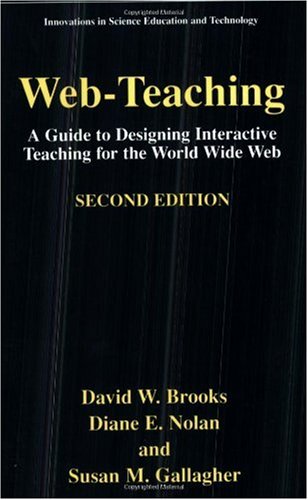
Web-Teaching, 2nd Edition


Web courses and Web-based course supplements have popped up all over the world. No central force has yet emerged which dominates the field. Indeed, nearly every college, from the large to the small, has become a player.
Tremendous, broad-based Web-delivery activity has characterized the last few years of the 20th century. Elementary students publish Web-sites. Teachers use Web-pages to communicate with parents.
Web-commerce has flourished. The wave of Web-commerce has paled that of Web-teaching. The infrastructure that is emerging to support Web-commerce ultimately will permit piggybacking of Web-teaching. We can expect fast Web access to be available in students' homes.
We see this edition as continuing to offer helpful, research-based suggestions to teachers who would improve their teaching using the Web. The first edition of Web-Teaching was somewhat dated when it came off the press. This edition also shoots at a quickly moving target. Much has happened in four years. Little has happened, however, to modify the principal messages of the first edition. This edition attempts to focus reader attention on research reported from the early days of Web teaching.

There are six things we can say about Web teaching at this time:
1. Course Management Software (WebCT, CourseInfo) has emerged and been embraced strongly by teachers. As a result, the number of teachers whose courses have some Web presence is mushrooming. For our first edition, Web teachers who managed their own servers represented a large fraction of those using the Web. This no longer is so; today few teachers manage their own Web servers.
2. The first edition suggested that Web teaching might not be successful in certain content areas. It turns out that Web teaching can be applied to nearly any non-laboratory course in the curriculum. Even portions of some laboratory and studio courses have been handled well on the Web.
3. While extensive studies are not available, early results suggest that students in Web courses learn about the same amount as do students in traditional courses. Drop out rates in Web-based courses are higher than in traditional courses, but similar to other distance courses.
4. There have been no results that suggest strong learning gains from multimedia approaches to teaching. Thus far, it appears that media have small effects. Active learning approaches have larger positive effects on learning outcomes.
5. Many teachers have developed Web supplements for their courses. There is very strong evidence that the students who use these resources learn better than those who do not.
6. Very few teachers have enjoyed time efficiencies as the result of developing a Web presence. Quite the opposite; teachers find that Web courses take more time. This is especially true of courses involving discussion, where reading Internet-based discussions can become an enormous chore.

By :
David Brooks, Diane Nolan, Susan Gallagher

May 26, 2012

Articulate Studio 12


Articulate Studio ’12 products share a single unified player, so learners navigate with one set of controls—even when courses include Articulate Quizmaker assessments and Articulate Engage interactions. The unified player also lets you list slide titles, quiz questions, and interaction steps on a single, consolidated menu.

Add illustrated and photographic characters to your courses, quizzes, and interactive e-learning content. Articulate Studio ’12 includes a character library with thousands of combinations of characters, expressions, and poses. Purchase additional Articulate character packs to extend your character library even more

Publish e-learning content to multiple formats so learners can interact with it on iPads, desktops, laptops, Android devices, and more. Articulate Studio ’12 products publish to Flash and to Articulate Mobile Player—a native iOS application that optimizes content for the iPad. Studio ’12 products also publish to HTML5, an increasingly popular format for rich multimedia content.

Localize your content with the right-to-left language support in Articulate Studio ’12. It also supports double-byte character sets (DBCS), so you can even translate your content into Chinese, Japanese, and Korean.

and more features.
It is Comming Soon

May 20, 2012

Nearpod is solution for the synchronized use of iPads in the classroom


An all-in-one solution for the synchronized use of iPads in the classroom.
Create, Engage and Assess
With Nearpod it’s easy, really easy.
Bring the classroom to life with interactive mobile
presentations that teachers create and
customize themselves.
And it’s free.

http://www.nearpod.com/